Every major technology shift changes what we make. The more interesting ones change what we value.
I started my career as the internet was reshaping design. Experiences that once lived in physical spaces, printed materials, call centers, and human interactions were moving online, and organizations had to learn new ways of bringing technology, business, and customer needs together.
AI feels different because of how quickly it is collapsing the distance between an idea and its execution. Product teams can synthesize research faster, explore more concepts, generate interfaces in minutes, and make ideas tangible before they would previously have been ready for discussion. That creates extraordinary leverage and puts more weight on the decisions that come before execution: understanding which problems matter and which possibilities are worth pursuing.
The Value Is Moving Upstream
The first wave of AI adoption naturally focuses on efficiency. Teams look for repetitive tasks to accelerate, ways to generate content faster, and opportunities to reduce the manual work required to move from insight to output.
That matters, but the more important change may be what happens around that efficiency.
A team exploring a new financial experience can now analyze competitive patterns, synthesize large amounts of customer feedback, generate multiple interaction approaches, and build early prototypes far more quickly than before. The amount of territory a team can explore before making a decision is expanding dramatically.
But access to more possibilities doesn’t automatically create better products. If a team uses AI to identify the same market patterns everyone else can see and then reproduces them, it may create a competent experience without creating a differentiated one.
The higher-value work shifts upstream, toward deciding which problems and signals actually deserve a team’s attention. AI can expand what we are able to explore, but the team still has to decide where that exploration should lead.
AI Expands the Search Space
Historically, exploration was constrained by time and capacity. Research had to be synthesized manually, competitive analysis could only go so deep, and designers might explore several viable directions because making twenty directions tangible simply wasn’t practical.
Those economics are changing. AI can help teams recognize patterns across research, compare experiences at scale, pressure-test assumptions, and rapidly make different ideas tangible. A small group can explore territory that once required more people, specialized skills, and time—giving teams greater permission to be more ambitious, not simply faster.
There is another implication of cheaper exploration that I find even more interesting: it gives teams greater permission to explore the new rather than simply improving what already exists.
Spotify wasn’t simply a redesign of iTunes, just as Airbnb wasn’t an attempt to build a better hotel. They reframed the experience and the value model around it. AI didn’t create those innovations, but they demonstrate what becomes possible when teams stop defining innovation exclusively through the products and categories that already exist.
AI changes the economics of pursuing that kind of thinking. Small teams can make unconventional ideas tangible earlier, explore experience and business models before committing significant investment, and test possibilities that might previously have been dismissed as too expensive or speculative.
The creative opportunity isn’t simply generating more solutions to problems we already understand. It’s creating enough space to question whether we’re solving the right problem at all, and whether an entirely different experience is now possible.
When Everyone Can Make, Taste Matters
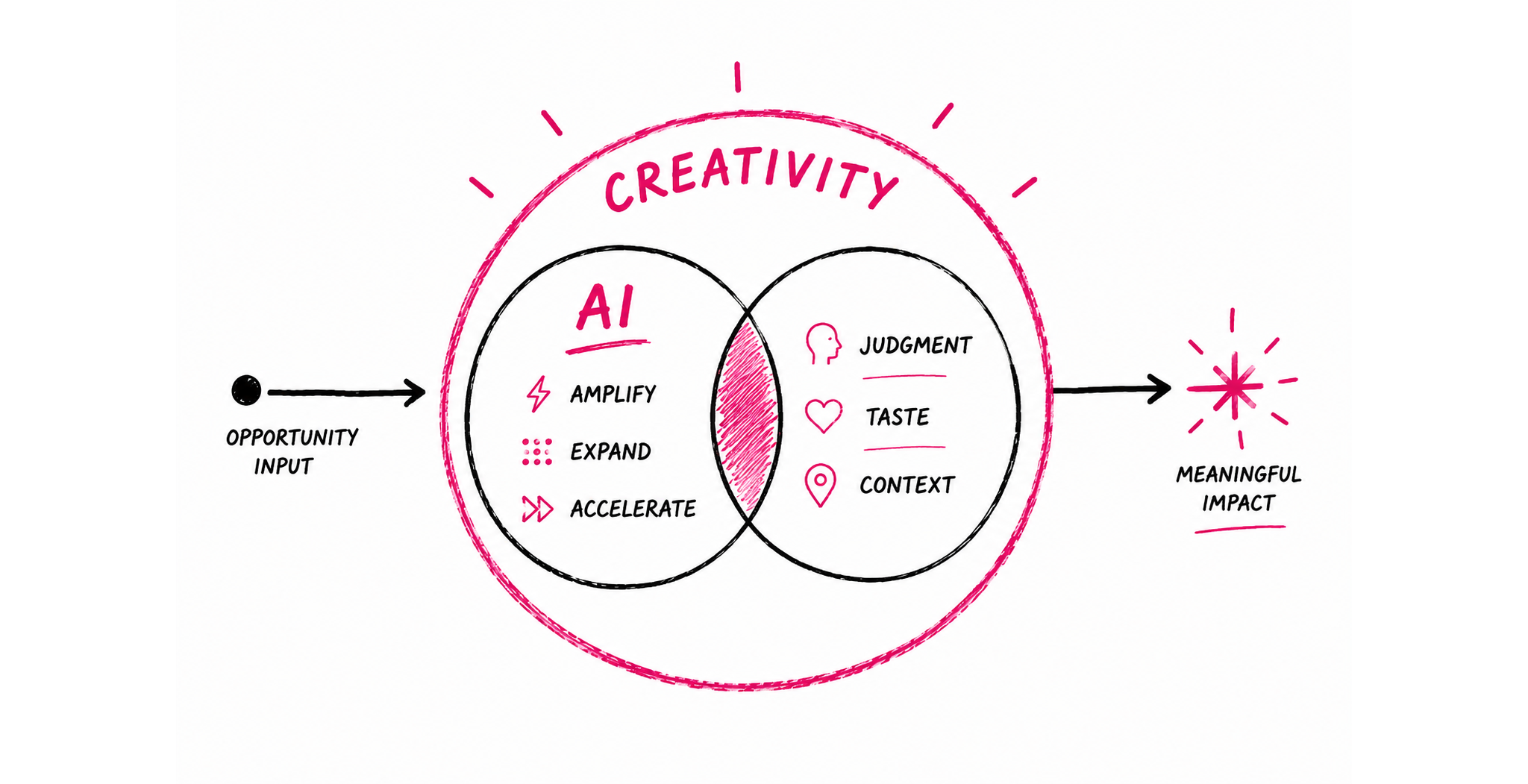
There is a counterweight to this abundance. AI is rapidly commoditizing many aspects of interface creation, with the same components, patterns, competitive references, and increasingly recognizable AI-generated aesthetic available to almost everyone. As competent execution becomes more abundant, taste becomes more important.
I don’t think of taste as purely visual preference. In customer experience, taste is the judgment required to understand what belongs in a particular moment for a particular audience.
AI can analyze onboarding across a category and identify the most common patterns. It can generate polished versions of those patterns almost instantly. What it cannot decide is how an experience should feel for an investor who finds financial information intimidating.
Should the experience simplify aggressively, or would that remove context the customer needs to feel confident? Should it create urgency, or would calm increase trust? Which information deserves emphasis? When does removing friction improve an experience, and when does deliberate friction help someone make a better decision?
Those choices draw on behavioral science, brand, customer understanding, craft, and business context. AI can inform them and generate options around them, but the product team still has to make the choice.
Those choices are increasingly where differentiation comes from.
The Human Edge Is Decision Quality
Some of the hardest product problems I’ve encountered haven’t been difficult because nobody could produce a solution. They’ve been difficult because intelligent people were looking at the same problem from different perspectives.
A product leader may see a growth opportunity. An engineer may see architectural complexity. A risk partner may identify an unintended consequence. A designer may see an issue of customer understanding or trust. Each can be correct within their own frame.
AI can improve those conversations by making competing ideas tangible earlier, synthesizing evidence, exposing assumptions, and helping teams understand the implications of different choices. What it cannot do is remove the need for alignment.
Product and design leadership still has to connect customer evidence, business strategy, technology realities, and organizational constraints into a coherent direction. That requires facilitation, strategic framing, persuasion, and storytelling, particularly when the answer is ambiguous and the evidence incomplete.
This is why I don’t see AI reducing the importance of creative leadership. It moves creative leadership away from overseeing artifact production and toward improving the quality of the decisions that produce those artifacts.
From Efficiency to Elevation
Inside large organizations, the most immediate AI opportunities are often framed around productivity. Where can teams move faster, automate repetitive work, or reduce the effort required to produce today’s deliverables?
Those are legitimate goals, but the more consequential leadership question is what we do with the capacity AI gives back.
In working with teams adopting AI, I’ve found the easiest conversation is often where it can save time. The harder—and ultimately more valuable—conversation is what we want teams to do differently once that time and capacity become available.
If designers reach a first concept faster, should we simply expect more concepts? If research synthesis takes less time, should the schedule just become shorter? If prototypes are dramatically cheaper to produce, should we simply produce more of them?
The greater opportunity is to use that capacity to let teams think bigger. Faster synthesis should create more time to understand customer behavior. Rapid prototyping should allow teams to investigate ideas before the organization invests heavily in them. AI should help expose assumptions earlier and give smaller teams permission to pursue creative bets that previously required significantly more resources.
This is the distinction I make between AI as a substitute and AI as an amplifier. Using AI as a substitute asks how today’s work can be produced with less effort. Using AI as an amplifier asks what better—or entirely new—work becomes possible because previous constraints have disappeared.
For product and design organizations, the second question is far more interesting.
Designing What Comes Next
As the cost of creating digital experiences continues to fall, I expect the role of design to keep moving upstream.
Designers will still create interfaces, but increasingly they will shape intelligent systems: how those systems behave, how they communicate uncertainty, when they intervene, when they explain themselves, and when they stay out of the way.
Design leaders will need enough AI fluency to recognize where these tools genuinely improve the work, and enough customer and strategic judgment to recognize when they don’t. The strongest teams will combine customer understanding, behavioral science, business strategy, technology, craft, and AI without confusing the speed of producing an answer with the quality of the answer itself.
AI gives product teams extraordinary leverage. We can explore possibilities and make them tangible much earlier than we could before, often with fewer people and less investment.
What matters is how we use that leverage. For me, the most interesting opportunity is giving teams more room to question the problem, explore ideas that previously felt impractical, and make better choices before significant investment begins. That is where I expect design to become more influential as AI becomes part of everyday product work.
Every major technology shift changes what we make. The more interesting ones change what we value.
I started my career as the internet was reshaping design. Experiences that once lived in physical spaces, printed materials, call centers, and human interactions were moving online, and organizations had to learn new ways of bringing technology, business, and customer needs together.
AI feels different because of how quickly it is collapsing the distance between an idea and its execution. Product teams can synthesize research faster, explore more concepts, generate interfaces in minutes, and make ideas tangible before they would previously have been ready for discussion. That creates extraordinary leverage and puts more weight on the decisions that come before execution: understanding which problems matter and which possibilities are worth pursuing.
The Value Is Moving Upstream
The first wave of AI adoption naturally focuses on efficiency. Teams look for repetitive tasks to accelerate, ways to generate content faster, and opportunities to reduce the manual work required to move from insight to output.
That matters, but the more important change may be what happens around that efficiency.
A team exploring a new financial experience can now analyze competitive patterns, synthesize large amounts of customer feedback, generate multiple interaction approaches, and build early prototypes far more quickly than before. The amount of territory a team can explore before making a decision is expanding dramatically.
But access to more possibilities doesn’t automatically create better products. If a team uses AI to identify the same market patterns everyone else can see and then reproduces them, it may create a competent experience without creating a differentiated one.
The higher-value work shifts upstream, toward deciding which problems and signals actually deserve a team’s attention. AI can expand what we are able to explore, but the team still has to decide where that exploration should lead.
AI Expands the Search Space
Historically, exploration was constrained by time and capacity. Research had to be synthesized manually, competitive analysis could only go so deep, and designers might explore several viable directions because making twenty directions tangible simply wasn’t practical.
Those economics are changing. AI can help teams recognize patterns across research, compare experiences at scale, pressure-test assumptions, and rapidly make different ideas tangible. A small group can explore territory that once required more people, specialized skills, and time—giving teams greater permission to be more ambitious, not simply faster.
There is another implication of cheaper exploration that I find even more interesting: it gives teams greater permission to explore the new rather than simply improving what already exists.
Spotify wasn’t simply a redesign of iTunes, just as Airbnb wasn’t an attempt to build a better hotel. They reframed the experience and the value model around it. AI didn’t create those innovations, but they demonstrate what becomes possible when teams stop defining innovation exclusively through the products and categories that already exist.
AI changes the economics of pursuing that kind of thinking. Small teams can make unconventional ideas tangible earlier, explore experience and business models before committing significant investment, and test possibilities that might previously have been dismissed as too expensive or speculative.
The creative opportunity isn’t simply generating more solutions to problems we already understand. It’s creating enough space to question whether we’re solving the right problem at all, and whether an entirely different experience is now possible.
When Everyone Can Make, Taste Matters
There is a counterweight to this abundance. AI is rapidly commoditizing many aspects of interface creation, with the same components, patterns, competitive references, and increasingly recognizable AI-generated aesthetic available to almost everyone. As competent execution becomes more abundant, taste becomes more important.
I don’t think of taste as purely visual preference. In customer experience, taste is the judgment required to understand what belongs in a particular moment for a particular audience.
AI can analyze onboarding across a category and identify the most common patterns. It can generate polished versions of those patterns almost instantly. What it cannot decide is how an experience should feel for an investor who finds financial information intimidating.
Should the experience simplify aggressively, or would that remove context the customer needs to feel confident? Should it create urgency, or would calm increase trust? Which information deserves emphasis? When does removing friction improve an experience, and when does deliberate friction help someone make a better decision?
Those choices draw on behavioral science, brand, customer understanding, craft, and business context. AI can inform them and generate options around them, but the product team still has to make the choice.
Those choices are increasingly where differentiation comes from.
The Human Edge Is Decision Quality
Some of the hardest product problems I’ve encountered haven’t been difficult because nobody could produce a solution. They’ve been difficult because intelligent people were looking at the same problem from different perspectives.
A product leader may see a growth opportunity. An engineer may see architectural complexity. A risk partner may identify an unintended consequence. A designer may see an issue of customer understanding or trust. Each can be correct within their own frame.
AI can improve those conversations by making competing ideas tangible earlier, synthesizing evidence, exposing assumptions, and helping teams understand the implications of different choices. What it cannot do is remove the need for alignment.
Product and design leadership still has to connect customer evidence, business strategy, technology realities, and organizational constraints into a coherent direction. That requires facilitation, strategic framing, persuasion, and storytelling, particularly when the answer is ambiguous and the evidence incomplete.
This is why I don’t see AI reducing the importance of creative leadership. It moves creative leadership away from overseeing artifact production and toward improving the quality of the decisions that produce those artifacts.
From Efficiency to Elevation
Inside large organizations, the most immediate AI opportunities are often framed around productivity. Where can teams move faster, automate repetitive work, or reduce the effort required to produce today’s deliverables?
Those are legitimate goals, but the more consequential leadership question is what we do with the capacity AI gives back.
In working with teams adopting AI, I’ve found the easiest conversation is often where it can save time. The harder—and ultimately more valuable—conversation is what we want teams to do differently once that time and capacity become available.
If designers reach a first concept faster, should we simply expect more concepts? If research synthesis takes less time, should the schedule just become shorter? If prototypes are dramatically cheaper to produce, should we simply produce more of them?
The greater opportunity is to use that capacity to let teams think bigger. Faster synthesis should create more time to understand customer behavior. Rapid prototyping should allow teams to investigate ideas before the organization invests heavily in them. AI should help expose assumptions earlier and give smaller teams permission to pursue creative bets that previously required significantly more resources.
This is the distinction I make between AI as a substitute and AI as an amplifier. Using AI as a substitute asks how today’s work can be produced with less effort. Using AI as an amplifier asks what better—or entirely new—work becomes possible because previous constraints have disappeared.
For product and design organizations, the second question is far more interesting.
Designing What Comes Next
As the cost of creating digital experiences continues to fall, I expect the role of design to keep moving upstream.
Designers will still create interfaces, but increasingly they will shape intelligent systems: how those systems behave, how they communicate uncertainty, when they intervene, when they explain themselves, and when they stay out of the way.
Design leaders will need enough AI fluency to recognize where these tools genuinely improve the work, and enough customer and strategic judgment to recognize when they don’t. The strongest teams will combine customer understanding, behavioral science, business strategy, technology, craft, and AI without confusing the speed of producing an answer with the quality of the answer itself.
AI gives product teams extraordinary leverage. We can explore possibilities and make them tangible much earlier than we could before, often with fewer people and less investment.
What matters is how we use that leverage. For me, the most interesting opportunity is giving teams more room to question the problem, explore ideas that previously felt impractical, and make better choices before significant investment begins. That is where I expect design to become more influential as AI becomes part of everyday product work.
About Gavin Cooper
Gavin Cooper is a UX executive and strategic advisor with over 20 years of experience helping product and design teams deliver meaningful digital experiences. He speaks regularly to executive leaders and university programs about UX strategy, AI, and organizational design.